
Typical Missions
The lowest-cost high-performance aerial firefighting platform available.
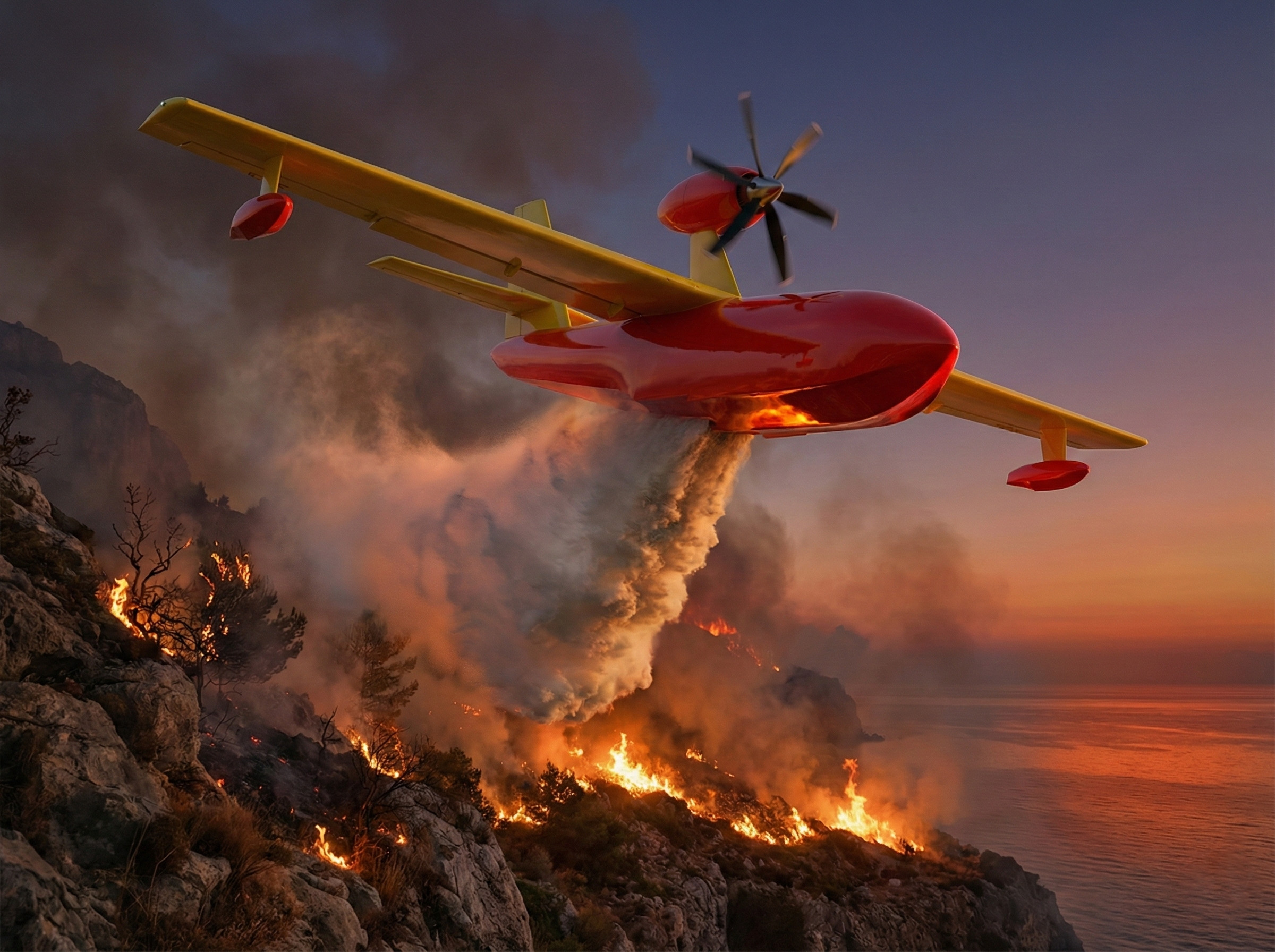
The Quencher is more than an aircraft — it is a flexible, autonomous firefighting system. Designed for scalability and precision, it adapts to different fire environments and mission requirements, from small regional outbreaks to full-scale national emergencies.
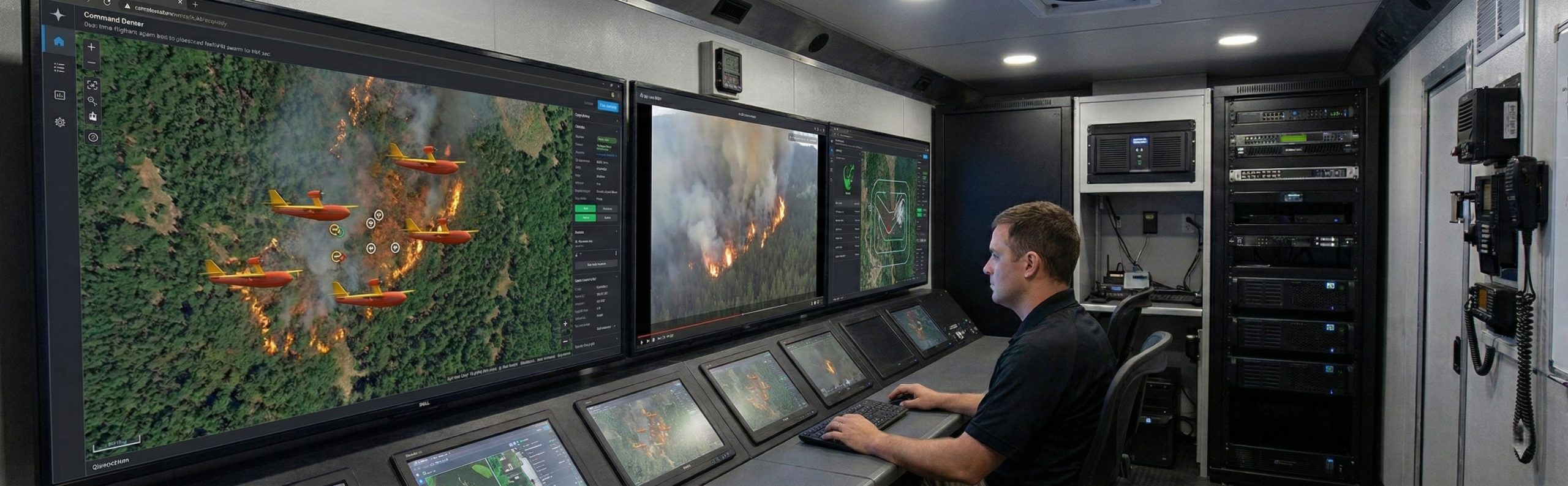
Unlike legacy water bombers, Quenchers do not require long repositioning or pilot rest cycles. Each mission is AI-driven, continuously updated with live data feeds, and coordinated in real time with other Quenchers in the field. This enables persistent suppression pressure that ground crews and conventional fleets cannot match.
Below are the most common operational scenarios
Wildfires spreading across rural or forested regions demand continuous suppression to stop expansion.
- How it works: A fleet of three Quenchers operates in a coordinated rotation. While one scoops water, the second climbs to altitude, and the third executes a precision drop. Each aircraft builds a real-time terrain and fire map using EO/IR sensors, radar, and satellite-linked data.
- Adaptive Intelligence: If wind direction changes or firelines shift, the AI instantly recalculates new drop routes to maximize effectiveness. Drops are placed with precision, day or night.
- Impact: This creates a continuous suppression loop, denying the fire time to advance.
- Advantage: Minimal manpower — one operator can supervise the entire mission, unlike crewed fleets that require multiple pilots and support crews
Remote, high-altitude fires are among the most difficult to control. Helicopters often lack payload capacity at altitude, while large crewed aircraft struggle with maneuverability.
- How it works: The Quencher climbs to 2,500 meters altitude with a full 5,000-liter payload. Onboard AI generates precise drop paths over ridges, valleys, and slopes, adjusting dynamically to fire spread.
- Adaptive Intelligence: Continuous mapping allows the Quencher to follow evolving firelines and re-route instantly in complex terrain.
- Impact: Enables direct suppression in areas previously unreachable by conventional aerial assets.
- Advantage: Expands operational reach to mountainous regions without compromising payload or safety.
Island communities face unique risks — limited firefighting resources and long wait times for reinforcements from mainland bases.
- How it works: Five Quenchers are permanently stationed in Rhodes, forming a regional aerial firefighting fleet. Each aircraft contributes to a shared fire map, coordinating autonomously to cover multiple ignition points.
- Adaptive Intelligence: If secondary fires break out or winds shift, the swarm redistributes itself in real time, optimizing coverage across the island.
- Impact: Collectively, the fleet delivers over 100,000 liters of water per hour, protecting villages, tourist areas, and natural reserves.
- Advantage: Because Quenchers are affordable, nations can deploy fleets locally in multiple regions, minimizing response times and ensuring faster containment.
Wildfires are most vulnerable to suppression at night, when cooler air and lower winds slow fire spread. Traditional aircraft are grounded during these hours, leaving fires unchecked.
- How it works: Quenchers continue operations around the clock, using infrared cameras, radar altimeters, and millimeter-wave radar to scoop and drop safely in total darkness.
- Adaptive Intelligence: AI continuously updates fire maps and mission profiles, recalculating routes to adapt to evolving nighttime conditions.
- Impact: Fires are attacked during their weakest phase, preventing flare-ups and allowing ground crews to consolidate gains.
- Advantage: Quencher is the only aircraft in the world capable of safe, large-scale 24/7 aerial firefighting.
When multiple large-scale fires ignite simultaneously, traditional fleets are overwhelmed. The Quencher enables truly scalable national defense against wildfires.
- How it works: A fleet of 20+ Quenchers is launched from dispersed regional bases. Each base operates with a small ground team, while AI-driven mission coordination builds a national fire map from satellites, drones, and ground sensors.
- Adaptive Intelligence: Quenchers reassign themselves automatically. If one fire escalates, more aircraft are sent there. If winds change, drop routes are recalculated instantly.
- Impact:
- Continuous suppression on multiple fire fronts simultaneously.
- Up to 100,000 liters/hour per regional swarm, multiplied nationally.
- Drastically reduced response times — aircraft are always close to ignition points.
- Advantage: For the first time, governments can field large, affordable fleets (dozens of aircraft, not single digits) to defend entire regions.
Every mission demonstrates how The Quencher transforms aerial firefighting:
- From reactive to proactive – thanks to continuous AI-driven mapping and adaptation.
- From limited to scalable – through affordability and swarm operations.
- From daytime to 24/7 – the world’s first true round-the-clock aerial firefighter.
The Quencher is not only versatile — it is the only platform capable of addressing modern wildfire challenges at scale, whether protecting a single community or an entire nation.