
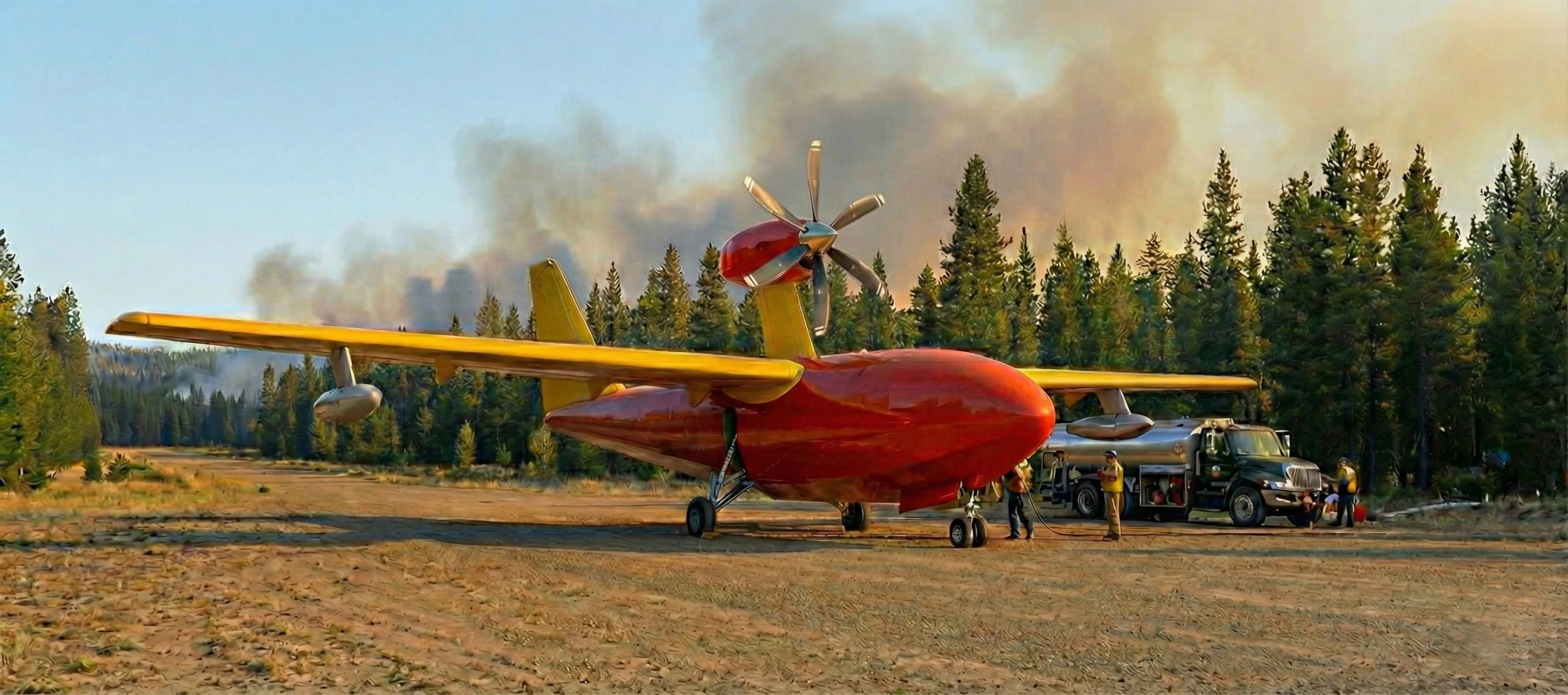
Operational Reality of Wildfire Suppression
The demand for aerial firefighting has increased sharply in recent years as wildfire seasons grow longer, more frequent, and more severe. Many countries have responded by ordering new firefighting aircraft, yet operational capacity continues to lag behind demand.
This is not due to a lack of aircraft deliveries, but to structural limits in how conventional aerial firefighting is performed.
Most existing and newly delivered fixed-wing firefighting aircraft remain:
- crewed and daylight-limited
- expensive to acquire and operate
- constrained by crew duty cycles and base availability
As wildfire activity expands, these limitations prevent fleets from scaling at the pace required.
The Capacity Gap
Wildfires do not stop at sunset. Fixed-wing aerial firefighting remains overwhelmingly a daylight operation.
Operational pauses — particularly overnight — allow fires to grow, increasing the scale, duration, and complexity of response the following day.
Adding more conventional aircraft does not fully resolve this gap. High acquisition costs, limited availability, and operational constraints restrict how many aircraft can be fielded and how long they can remain active.
The result is a persistent mismatch between fire behaviour and suppression capacity.
A System Aligned with Modern Demand
Addressing today’s wildfire environment requires a different operational model.
An unmanned, AI-assisted aerial firefighter, capable of operating continuously over 24 hours and deployed at fleet scale, directly addresses the capacity gap created by conventional systems.
By removing onboard crew limitations and reducing unit cost, this approach enables:
- sustained day-and-night suppression
- greater aircraft availability per season
- scalable deployment aligned with growing demand
Rather than relying on a small number of high-cost assets, continuous aerial suppression becomes achievable through numbers, persistence, and affordability.
Meeting Demand Through Scale, Not Size
The challenge facing aerial firefighting is no longer aircraft performance alone, but capacity at scale.
Systems that combine unmanned operation, autonomous assistance, and low cost per unit are increasingly necessary to meet the operational demands of modern wildfire suppression.
Quencher is designed to meet this demand by aligning aerial firefighting capability with the realities of today’s wildfire environment.